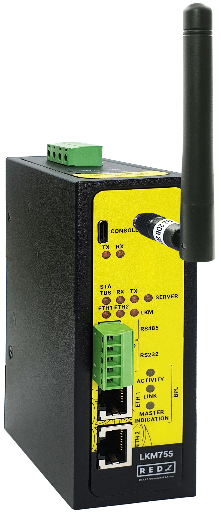
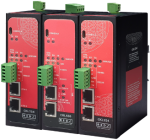
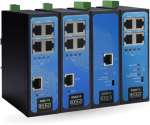
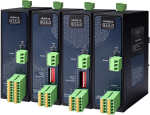
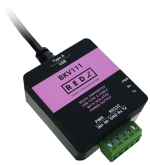
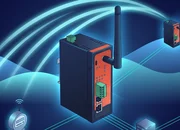
- 2 x 10/100Base-T(X) ports + 1 x BPL link
- 1 x RS232 and 1 x RS485 serial port
- Embedded web interface
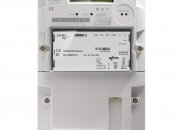
- Reads electricity meters with IEC 62056-21 (Mode C), DLMS/COSEM, and DLMS/COSEM with IEC 62056-21 opening
- Meter side start baud rate selectable from 300 to 115200 baud for each meter
- 2 device functions:
- Serial Electricity Meter to Modbus TCP Gateway (and MQTT Publisher): meters on the RS232 or RS485 port, data given out as Modbus TCP (and MQTT)
- TCP/IP Electricity Meter to Modbus RTU Gateway (and MQTT Publisher): meters on the network (IP address and TCP port of each meter), data given out as Modbus RTU on the RS232 or RS485 port (and MQTT)
- Up to 32 meters (IEC 62056-21 and DLMS/COSEM), data converted to Modbus TCP or Modbus RTU
- Up to 48 OBIS codes per meter profile, 6 profiles (IEC 62056-21, Landis+Gyr DLMS, Actaris/Itron, Iskra DLMS, Cewe DLMS, Generic DLMS), all set from the web interface
- Several IEC meters on one RS485 line: a read-out that comes from another meter than the one asked is not stored
- Negative meter values keep their sign; a value too large for the 32-bit register gives a fixed limit value
- Modbus TCP server with up to 10 clients at the same time, or Modbus RTU output from 300 to 460800 baud
- Function code 03 (Read Holding Registers); every value is 32 bits = 2 registers, 48 values per meter row
- MQTT publisher with two data formats (OBIS VALUES AS OBJECTS and OBIS VALUES AS MODBUS FRAME), at the same time as Modbus
- 868 MHz LoRaWAN Meter Reader: the meter data is also sent to a LoRaWAN network server through a LoRaWAN gateway
- Radio band EU 868 MHz (Europe); the send interval is set by the user
- Built-in duty cycle check and payload size check: the device splits the data by the maximum payload size and the duty cycle block times, so the meters can be read at any interval
- Activation over the air (OTAA) or by personalization (ABP); Class A or Class C
- Adaptive Data Rate, selectable uplink data rate and Tx power level (EIRP), user defined LoRaWAN port, with or without ACK
- Device and LoRaWAN status on the LoRa Status page, including the latest LoRaWAN messages
- Up to 30 Mbps PHY rate on BPL with up to 10 hops and 1000 nodes
- Up to 432 sub-carriers from 2 to 28 MHz analog bandwidth; LDPC-C FEC with 128-bit AES core
- Plug and play; master or node selected on the web interface
- Wide range 3 phase AC input, 110 - 240 V, 50 - 60 Hz (versions -PN-AC and -PP-AC), or 9 - 36 V DC input (version -PP-DC)
- Three versions: -PN-AC (three-phase AC power, phase to neutral BPL data connection), -PP-AC (three-phase AC power, phase to phase BPL data connection), -PP-DC (9 - 36 V DC power, phase to phase BPL data connection)
- Supports Full/Half-Duplex, auto MDI/MDI-X on each port
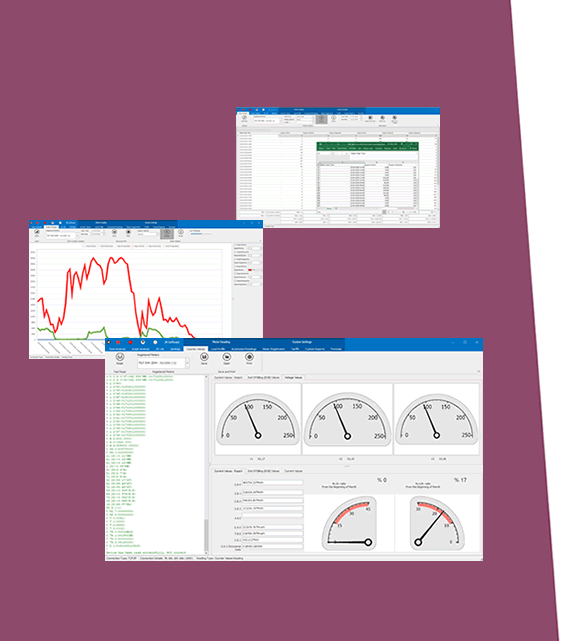
- Meter reading, Modbus communication and OBIS-to-Modbus mapping status, and the meter read-out data, on the web interface
- Device Status overview cards for the meters, Modbus, MQTT and LoRaWAN, each with a green, amber, red or grey dot
- White list or black list IP filter with up to 20 IP addresses (in the Modbus TCP function)
- DHCP server
- Firmware update over the web interface; 2 firmware banks in the device (1 active), the previous firmware can be started again
- Configuration backup and restore as a file
- Operating temperature -25 to 70 C (AC versions), -40 to 85 C (DC version)
- Rugged metal IP-40 housing
- DIN-rail mounting
LoRaWAN TECHNOLOGY - 868 MHz
Radio Band
EU 868 MHz (Europe)
Radio Module
pre-certified according to EN 300 220
Sensitivity
down to -138 dBm
Link Budget
up to 156 dB
Communication Distance
up to 15 km (line of sight)
Sensitivity, link budget and distance are the values of the radio module datasheet.
Tx Power Level (EIRP)
0 to 16 dBm, configurable
Uplink Data Rate
LoRa SF12 / 125 kHz / 250 bps to LoRa SF7 / 125 kHz / 5470 bps, or Adaptive Data Rate
Activation
Over-the-Air (OTAA) or by Personalization (ABP)
LoRaWAN Class
Class A or Class C
LoRaWAN Port
user defined (meter data; factory 3)
Transmission
without ACK or with ACK
LoRaWAN UPLINK DETAILS - LKM
After every join the gateway sends, in this order: a LoRaWAN time request (DeviceTimeReq) to set its clock, the status message (port 1), the OBIS details message (port 2, only if "Send OBIS Code Details as Status Message At Start" is on), then the meter data messages ("LoRaWAN Port", factory 3).
A step that cannot be completed in 5 tries or 180 seconds is skipped, so meter data is never blocked by the first steps.
Every message starts with the device ID (4 bytes) and one byte with the message type (0 = status, 1 = OBIS details, 2 = meter data) and the package number.
A message longer than the maximum payload is sent as several packages.
The byte layout of each message and a payload formatter for the network server are given in chapter 14 "LoRaWAN Communication Example" of the user manual.
ETHERNET TECHNOLOGY
Ethernet Standards
IEEE 802.3 for 10Base-T
IEEE 802.3u for 100Base-T(X)
IEEE 802.3x Flow Control
Mac Table
1K MAC address entry
Processing
Store-and-Forward
Memory
448K bits packet buffer memory
BPL (BROADBAND POWERLINE) TECHNOLOGY
PHY Data Rate
up to 30 Mbps
Hops and Nodes
up to 10 hops and 1000 nodes
Sub-carriers
up to 432 sub-carriers from 2 to 28 MHz analog bandwidth
FEC and Encryption
LDPC-C FEC with 128-bit AES core
Master or Node
selected on the web interface ("BPL Operating Mode": MASTER / NODE)
MAC Layer Protocol
CSMA/CA
Modulation Technology
OFDM-432
VLAN
IEEE 802.1Q / IEEE 802.1p
Connect the unit to a network over one path only: over the power line or over an Ethernet cable. If it reaches the same network over both, the network has a loop; packets are lost and firmware uploads are cut.
NTP TIME SYNCHRONIZATION - LoRaWAN Models
NTP Server
"NTP Server IP or URL", default pool.ntp.org
The clock is kept by the LoRaWAN radio module. From 10 minutes after start-up the unit compares it with the NTP time every hour and corrects it when the difference is 5 seconds or more (no restart). The clock can also be set from the Management page ("Set Device Time").
No battery for the clock: after a power cut set the time again, from an NTP server or with "Set Device Time".
METER READING DETAILS - LKM
Meter Rows
Up to 32 meter rows; the enabled rows are read one after the other
Protocols
IEC 62056-21 (Mode C), DLMS/COSEM, DLMS/COSEM with IEC 62056-21 opening
Meter Interface
RS232 or RS485, set for each meter row (Serial Electricity Meter to Modbus TCP Gateway (and MQTT Publisher)); or meters on the network, IP address and TCP port for each row (TCP/IP Electricity Meter to Modbus RTU Gateway (and MQTT Publisher))
Start Baud Rate
300, 600, 1200, 2400, 4800, 9600, 19200, 38400, 57600 or 115200 for each meter; the unit changes to the baud rate offered by the meter
IEC 62056-21 Settings
IEC address, reading table code (0 to 9), init string (sent 0 to 4 times to wake up the meter), IEC meter line control (7_EVEN_1, 8_NONE_1, 8_EVEN_1)
DLMS/COSEM Settings
meter type, DLMS address, address size (1, 2 or 4 bytes), client type (Management, DataCollection, Electricity, End Customer, Public, ManufacturerSpecific_32), OBIS reference (short names or long names), authentication (Low Security with password, or No Security)
Query Interval
1 to 65535 s for each meter (shortest time between two readings; the real interval can be longer when many meters or long read-out lists are configured)
Time Out
1 to 30 s for each meter
OBIS Codes
up to 48 OBIS codes for each meter profile (IEC 62056-21, Landis+Gyr DLMS, Actaris/Itron, Iskra DLMS, Cewe DLMS, Generic DLMS), set from the web interface
MODBUS DETAILS - LKM
Function Code
03 Read Holding Registers only
Register Size
every value is 32 bits = 2 registers; 48 values per meter row (OBIS index 0 to 47)
Address Rule
address = (meter row - 1) x 256 + 2 x OBIS index (row 1 starts at 0, row 2 at 256, row 3 at 512 ...)
Request
an even number of registers, 2 to 124; each meter row needs its own request
Unit ID / Slave Address
Gateway Modbus Address, 1 to 247 (factory 1)
Byte Order
big-endian inside each register; word order set by "Modbus Word (Register) Swap"
Modbus TCP
port 502 (factory); 1 to 10 masters at the same time (factory 2)
Modbus RTU
RS232 and / or RS485; baud rate 300 to 460800 (factory RS485, 115200, 8_NONE_1); in the function TCP/IP Electricity Meter to Modbus RTU Gateway (and MQTT Publisher)
Exception Responses
none - a request that cannot be served gets no answer
MQTT DETAILS - LKM
MQTT Publisher
in both device functions, at the same time as Modbus; one message per meter row after a successful reading
Connection
broker IP or URL and port, client ID, user name and password, publish topic and subscribe topic; MQTT 3.1.1 over plain TCP (no TLS encryption), QoS 0
Data Send Interval
"Minimum Send Interval for a Parsed Data (in seconds)", 0 to 65535 s, factory 60 s - the shortest time between two messages of the same meter row
Data Format
OBIS VALUES AS OBJECTS (one JSON object per meter row, OBIS codes and values as text) or OBIS VALUES AS MODBUS FRAME (one hex string: the data part of a Modbus answer with all 48 values of the row)
Time
with the time from NTP every message carries the time as UTC Unix seconds
Broker not reachable
the gateway tries again at most once every 5 seconds and does not restart because of MQTT; meter reading, Modbus and the web pages keep working
WEB MONITORING DETAILS - LKM
Device Status
overview cards for the meters, Modbus, MQTT and LoRaWAN with a green, amber, red or grey dot; communication counters
Gateway Status
the result of the last readings and the value stored for every OBIS code, for the last read meter or a selected meter row
Meter Reading Status
the last 210 lines of the meter communication - the data received from IEC meters and the messages of the unit about the readings; the OBIS codes are typed as they appear in the read-out list of the meter
LoRa Status
device and LoRaWAN status, including the latest LoRaWAN messages
CONNECTORS AND PORTS - LoRa
SMA Antenna Connector for LoRa
1 Standard SMA female interface, 50 ohm
Console Port
USB Type C or Micro USB connection for LOG in 115200 baud
10/100T(X) RJ45 Ports
Ethernet Connection on 2 ports
Serial Ports
5 pin terminal block: RS232 Tx, Rx and GND; RS485 A, B and GND
Reset Buttons
Reset to Factory Settings Buttons
LED INDICATORS
Power Indicator
Power LED
10/100T(X) Indicators
Activity LEDs:
ETH1, ETH2 and Activity of device itself (Marked as device series name, such as CKL/TLM/HUR/LKM)
System Indicators
Status LED,
Tx and Rx of data LEDs and Server LED
Server LED: ON when the device function is Serial IEC Meter to Modbus TCP Gateway, OFF when it is TCP/IP IEC Meter to Modbus RTU Gateway.
Console Indicators
Tx and Rx of data LEDs
LED INDICATORS - BPL
BPL LEDs
-BPL Activity
-BPL Link
-MASTER: On when the device is set as BPL master
POWER - BPL
Power Connection
The LKM755 is powered over terminal pins 1 and 2 only. On the AC version the terminals are marked L3, L2, L1 and N: power is connected to L1 and N (pins 1 and 2), the other two terminals (L2 and L3, pins 3 and 4) are data terminals.
Versions
AC powered: three-phase AC, 110 - 240 V, 50 - 60 Hz. DC powered: 9 - 36 V DC.
Data Connection - Phase to phase (PP)
Data is carried over terminal pins 3 and 4. Connect two phases to these pins (L1-L2, L2-L3 or L1-L3). Where two phases are not available, a phase and neutral can be connected to pins 3 and 4.
Data Connection - Phase to neutral (PN)
The device is powered from phase and neutral on pins 1 and 2 and also carries data over these pins. Pins 3 and 4 are optional.
Data Connection - DC
Data is carried over a DC power line, for example 24 V and GND, on terminal pins 3 and 4.
The AC powered version is made with the PP or the PN data connection, the DC powered version with the PP data connection.
PHYSICAL AND ENVIRONMENTAL CHARACTERISTICS - BPL MODELS
Enclosure
Metal, IP40
Dimensions
43 x 95 x 124 mm (w x d x h)
Weight
about 400 g
Storage Temperature
-65 to 150 C
Operating Temperature
-25 to 70 C (AC versions), -40 to 85 C (DC version)
Operating Humidity
10 to 95 %, non-condensing
Mounting
DIN rail
LKM755-PN-AC: 868 MHz LoRaWAN Meter Reader and Electricity Meter Protocol to Modbus Protocol Gateway with MQTT, 2 x 10/100Base-T(X) Ethernet ports and 1 x BPL (Broadband Power Line) link, 1 x RS232 and 1 x RS485, three-phase AC power input, 110 - 240 V, 50 - 60 Hz, phase to neutral (PN) data connection
LKM755-PP-AC: 868 MHz LoRaWAN Meter Reader and Electricity Meter Protocol to Modbus Protocol Gateway with MQTT, 2 x 10/100Base-T(X) Ethernet ports and 1 x BPL (Broadband Power Line) link, 1 x RS232 and 1 x RS485, three-phase AC power input, 110 - 240 V, 50 - 60 Hz, phase to phase (PP) data connection
LKM755-PP-DC: 868 MHz LoRaWAN Meter Reader and Electricity Meter Protocol to Modbus Protocol Gateway with MQTT, 2 x 10/100Base-T(X) Ethernet ports and 1 x BPL (Broadband Power Line) link, 1 x RS232 and 1 x RS485, 9 - 36 V DC power input, phase to phase (PP) data connection