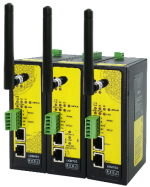
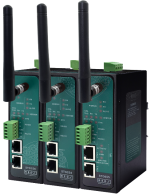
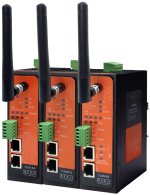
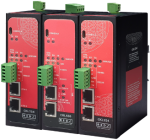
- 2.4 GHz LoRa radio
- LoRa or FLRC modulation
- LoRa bandwidth 200, 400, 800 or 1600 kHz
- Radio power -18 dBm (about 0.02 mW) to 13 dBm (about 20 mW)
- Two 10/100Base-T(X) Ethernet ports on a built-in Ethernet switch
- One RS232 and one RS485 serial port (one of them is used at a time), 300 to 460800 baud
- Embedded web interface for all settings and for status and traffic information
- Four device functions:
- LoRa to TCP/UDP Server Gateway
- LoRa to TCP/UDP Client Gateway
- LoRa to SERIAL Device Gateway, which can also convert Modbus TCP to Modbus RTU and Modbus RTU to Modbus TCP
- LoRa Repeater
- Radio network:
- Point to point
- Point to multipoint (broadcast)
- Point to multipoint with a TCP socket to target device list
- Discovery of the other TLM modems of the same LoRa network, with their signal levels, addresses and settings
- Remote ping, link test and remote node information for installation
- 128-bit AES encryption of the radio data
- Configurable receive and transmit group address and device address
- Acknowledged transmission (C-Data) on the radio; the radio module of the 2.4 GHz models listens before talk by itself
- Modbus Unit ID routing and UDP server mode in the server gateway
- IEC 62056-21 Mode C baud switching in the serial gateway
- Up to 10 TCP clients in the server gateway function
- DHCP server
- NTP time synchronization
- White list and black list filter for LoRa packets
- Firmware update over the web interface; two firmware images are stored, one of them is active
- 5 - 48 V DC power input (60 V maximum), protected against reverse polarity
- Operating temperature -40 to +85 C
- Rugged metal housing, IP40
- DIN rail mounting
LoRa TECHNOLOGY - 2.4 GHz
Certification
Radio module pre-certified according to EN 300 328
Sensitivity
Down to -130 dBm
Transmit Power
-18 to 13 dBm, configurable
Link Budget
Up to 142 dB
Communication Distance
More than 12 km line of sight
Sensitivity, link budget and distance are the values of the radio module datasheets.
The distance that can be bridged depends on the antennas, their height, the terrain and the radio settings. Check each link on site with the link test on the LoRa Status page.
Frequency Range
2402.000137 to 2479.999939 MHz
LoRa Bandwidth
200, 400, 800, 1600 kHz
LoRa Spreading Factor
SF5 to SF12
Modulation
LoRa or FLRC
User Data per LoRa Packet
109 bytes; a longer message is sent as several packets
Encryption
128-bit AES; all modems of one network use the same radio settings and, if AES encryption is used, the same key
Acknowledged Transmission (C-Data)
off at the factory. Listen Before Talk: no setting, the radio module listens before talk by itself
When Tx Device Address is changed from 65535 to a single modem and saved, the modem also turns on Acknowledged Transmission (C-Data) once. C-Data can be turned off again afterwards.
LoRa NETWORK DISCOVERY
Every modem keeps a list of the modems it has received packets from, with RSSI, SNR, address and the age of the last packet; Request LoRa Connections adds the device function and the connections of each modem.
The LoRa Status page also offers a ping of an IP device behind a remote modem, a link test and remote node information.
These tools reach only the modems in direct radio range; a LoRa Repeater does not pass them.
ETHERNET TECHNOLOGY
Ports
2 x 10/100Base-T(X), RJ-45, on a built-in switch
Ethernet Standards
IEEE 802.3 (10Base-T), IEEE 802.3u (100Base-TX), IEEE 802.3x flow control
MAC Table
1K entries
Processing
Store-and-forward
Packet Buffer
448 kbit
MODBUS AND SERIAL - TLM
Modbus TCP to RTU
the field modem turns the Modbus TCP request into a Modbus RTU frame; the Unit ID becomes the slave address.
An exception answer of the slave is passed on to the master. Optional Modbus exception 0x0B (gateway target device failed to respond) when a slave does not answer; off at the factory.
Modbus routing by Unit ID
up to 5 rows of Unit ID ranges, each sent to the LoRa address of one field modem.
Modbus RTU master to TCP
a serial Modbus RTU master reads slaves behind other modems with the same routing table.
IEC 62056-21 Mode C
the serial gateway follows the Mode C handshake and changes its baud rate to the speed the meter offers.
NTP TIME SYNCHRONIZATION - TLM
The modem compares its clock with the time server 10 minutes after start-up and then every hour. If the difference is 5 seconds or more, the clock is corrected without a restart.
The modem clock runs in UTC: the time server gives UTC, and there is no time zone setting.
The modem needs a working gateway and DNS server to reach a time server given by name.
Without an answer from the time server a time set by hand stays as it is.
CONNECTORS AND PORTS - TLM
SMA Antenna Connector
standard SMA connector, 50 ohm, male
Console Port
log output only, 115200 baud - micro USB on earlier hardware, USB Type-C on current hardware; the USB serial chip is made by FTDI, the driver is on https://redz-sc.com/en/support/driver
10/100T(X) RJ45 Ports
Two 10/100Base-T(X) Ethernet ports (RJ-45)
Serial Ports
5 pin terminal block, from the top A, B, GND, RX, TX - RS485 uses A, B and GND, RS232 uses GND, RX and TX
Reset Buttons
RESET TO SERVER and RESET TO CLIENT. With firmware 3.00.01 both do the same: held for more than 5 seconds, either one restores the factory settings and restarts the modem.
LED INDICATORS
Power
on while the modem is powered
Ethernet
activity LEDs for port 1, port 2 and the modem itself
STATUS
blinks (once per second) after power-up. Server and client gateway: blinks while no TCP connection is open, on while a TCP connection is open. Serial gateway and repeater: on.
Device Tx / Rx
flash when the modem sends or receives data on the Ethernet side, on the serial line or to and from its radio module
SERVER
on when Device Function is LoRa to TCP/UDP Server Gateway, off for every other device function
LoRa
ALIVE blinks during normal operation of the radio module; Tx and Rx blink when the radio sends or receives a packet
Console
Tx and Rx blink while data passes over the console port
POWER - DC
Input Range
5 - 48 V DC (60 V maximum)
Protection
reverse polarity protection, thermal shutdown and current limit
PHYSICAL AND ENVIRONMENTAL CHARACTERISTICS - DC MODELS
Enclosure
Metal, IP40
Dimensions
43 x 95 x 124 mm (w x d x h)
Weight
about 400 g
Storage Temperature
-65 to +150 C
Operating Temperature
-40 to +85 C
Operating Humidity
5 to 95 %, non-condensing
Mounting
DIN rail
TLM194: 2.4 GHz LoRa RF Modem, 2 x 10/100Base-T(X) Ethernet ports, 1 x RS232 and 1 x RS485, 5 - 48 V DC power input (60 V maximum)