We use cookies to optimize site functionality and provide the best possible experience.
View our new Privacy and Protection of Personal Data here.
Accept Settings
< ALL Posts

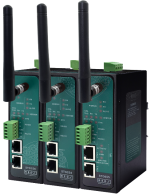
Extend the Range of Wireless M-Bus Devices with STG Series (by REDZ) Repeater Function

02.01.2025

Updated for firmware 3.00.00 (first published 02.01.2025).

1. Introduction

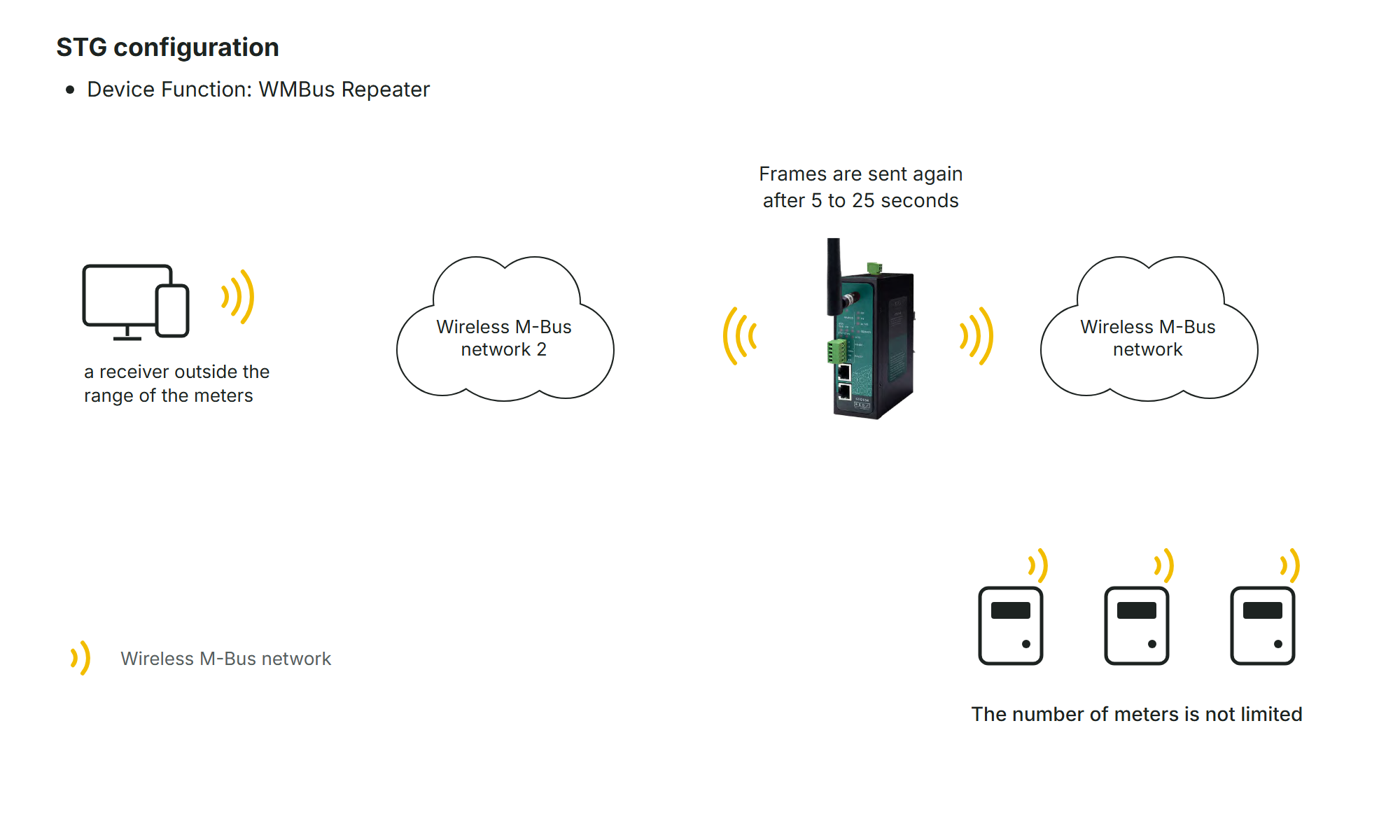
Wireless M-Bus (wM-Bus) is a widely used protocol for smart metering applications, enabling efficient data transmission from utility meters to data collection systems. However, in large industrial sites, urban environments, or buildings with thick walls, signal coverage can become a challenge. Every STG Series gateway can work as a WMBus Repeater: it sends received WMBus frames to the air again, so that a receiver outside the range of the meters can still read them.
2. Why Extend the Wireless M-Bus Range?

1. Overcoming Signal Obstacles – Buildings with thick walls, basements, or underground installations can weaken the signal.

2. Covering Large Areas – Industrial sites, smart cities, and large residential complexes require extended range.

3. Improving Data Reliability – Weak signals lead to data loss, increasing transmission retries and power consumption.

4. Reaching distant meters – the repeater sends their frames to the air again, so that a receiver outside their range can still read them.

3. How the STG Series Repeater Function Works

Select WMBus Repeater as the Device Function on the Operating Mode page.

1. Reception – the repeater receives the WMBus frames of the meters in the selected reception mode (S - Mode, T - Mode or C / T - Mode ( combined reception of T and C Mode messages )). No meter list is needed and the number of meters is not limited; only the white list / black list decides which meters are repeated.

2. Delay – each frame is sent again after a random delay of 5 to 25 seconds; up to 16 frames wait for their delay at the same time.

3. Sending – frames are transmitted with the Tx Package Transmission Mode (S, T or C mode) and the Tx Power Level (-1 dBm to 13 dBm) of the WMBus Settings page.

4. No loops – in a frame that carries a hop bit the repeater sets this bit before it sends the frame; a frame whose hop bit or repeated-access bit is already set is not sent again, so two repeaters do not feed each other. A frame without a hop bit that was already repeated is not repeated again within 60 seconds.

5. Repeater address – the repeater sends its own SND-NKE telegram 2 to 5 seconds after it has repeated an installation telegram of a meter, unless Repeater Manufacturer ID (hex) and Repeater Device ID (hex; both IDs 0 = SND-NKE off) are both 0.

Keep the AES keys of the meters out of the repeater: a meter whose key is entered is repeated decrypted, and the receiving gateway cannot read it. The keys belong in the gateway that reads the meters.

The repeater works without an Ethernet connection; the network is needed for the web interface only. MQTT and Modbus are not available in this function.

4. Benefits of Using STG Series Repeaters

✔ Extended Range – a receiver outside the range of the meters can still read them.

✔ Stand-alone operation – no Ethernet connection and no meter list needed.

✔ Easy Deployment – simple setup with configurable parameters: transmission mode, output power, filters.

5. Use Cases

• Smart Metering in Residential and Commercial Buildings

• Industrial Facilities with Wireless Monitoring

• Smart Cities and IoT Deployments

• Water, Gas, and Electricity Metering Networks

6. Conclusion

Extending the range of Wireless M-Bus devices is crucial for ensuring uninterrupted data transmission in large or complex environments. The STG Series by REDZ provides an efficient Repeater Function, offering a cost-effective, reliable, and easy-to-deploy solution for smart metering and IoT applications.

The repeater function is described in chapter 9.7 "Scenario 6 - WMBus repeater" and chapter 10.6 "WMBus Settings" of the STG user manual.
 

< ALL Posts
LKM Series Electricity Meter Protocol to Modbus Protocol Gateways with MQTT (and LoRaWAN)
STG Series WMBus (Wireless MBus) - Modbus Protocol Gateway with MQTT
TLM Series LoRa Modems and LoRaWAN EndNode Modems
CKL Series Modbus TCP and RTU Gateways and Serial to Ethernet Gateways
BSB Series Industrial Unmanaged Ethernet Switch (with Broadband Power Line)
KMK Series Optical Probes for Energy Meters
HUR Series Modbus TCP and RTU Remote I/O Devices with MQTT (and LoRaWAN)
BKV Series Industrial Converters and USB Tools
MBC Series IEC62056-21 Protocol Auto Baud Changer
KMK Series Optical Probes for Energy Meters
REDZ Software Solutions
LoRaWAN
LoRaWAN
In today's rapidly digitizing world, IoT (Internet of Things) devices and applications are becoming increasingly prevalent. In this context, long-range wireless communication technologies play a significant role. One such technology that stands out is LoRa, which offers an innovative solution for low-power, long-range wireless communication.
MQTT
MQTT
As the Internet of Things (IoT) continues to grow, the demand for efficient, lightweight, and reliable communication protocols becomes essential. One of the most popular protocols meeting these demands is MQTT (Message Queuing Telemetry Transport).
Broadband Power Line (BPL)
Broadband Powerline Technology (BPL), also known as Powerline Communication (PLC), represents a revolutionary approach to data transmission, leveraging the existing electrical power infrastructure to deliver broadband internet connectivity.
Wireless MBus (WMBus)
In an era defined by connectivity and data-driven decision-making, the need for efficient and reliable metering solutions has never been greater. Enter Wireless M-Bus (Meter-Bus) technology, a versatile and robust platform designed to revolutionize remote meter reading and data communication in utility management systems.
IEC62056-21 (for Electricity Meters)
IEC 62056-21 is an international standard for communication with electricity meters. Developed by the International Electrotechnical Commission (IEC), this protocol standardizes the way data is exchanged between meters and various devices or systems, ensuring interoperability and efficient data management.
DLMS/COSEM (for Electricity Meters)
DLMS/COSEM (Device Language Message Specification / Companion Specification for Energy Metering) is the global standard for smart energy metering. It provides a highly secure, interoperable framework for reading and managing energy data across diverse utility networks.
P1 Companion Standard (for Electricity Meters)
Smart energy meters have become essential in monitoring and controlling energy usage. To facilitate better integration, communication, and functionality of these smart meters, standards are crucial. One such standard, particularly relevant in Europe, is the P1 Companion Standard.
Modbus RTU
Modbus RTU
Modbus RTU is a widely recognized and utilized communication protocol in the field of industrial automation. Developed by Modicon (now Schneider Electric) in 1979, it was designed to facilitate communication between various electronic devices, primarily programmable logic controllers (PLCs).
Modbus TCP
Modbus TCP
Modbus TCP, also known as Modbus TCP/IP, is a widely adopted communication protocol in the industrial automation sector. It was developed to enable Modbus communication over Ethernet networks, combining the reliability and simplicity of the Modbus protocol with the versatility of Ethernet.
LoRa RF Communication
LoRa stands for Long Range and is a proprietary wireless modulation technique developed by Semtech. Essentially, LoRa is the physical layer, or the hardware, that allows long-range communication between devices.
MBus
MBus
M-Bus (Meter-Bus) is a robust European standard specifically designed for the remote reading of utility meters, such as electricity, gas, water, and heat. It utilizes a simple, polarity-independent two-wire system that transmits both data and power over long distances, making it highly cost-effective and immune to industrial noise.